
Latest
Industry

40% of Game Developers Use Gen-AI, but Over Half Warn of Harm in GDC Study

The landmark State of the Game Industry survey of 2,600 professionals reveals expanding tool adoption alongside surging developer alarm over labor, craft, and skill atrophy.

Read the story
Industry · Read the story
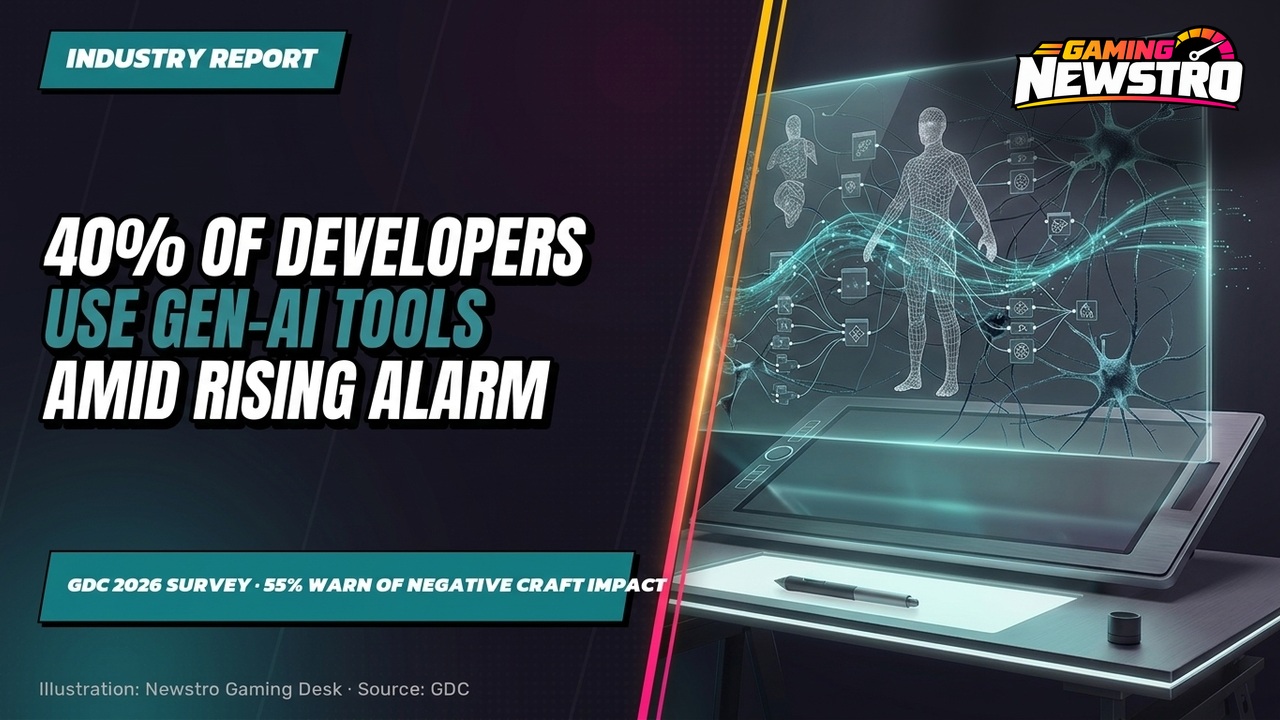
Dark-mode Gaming Newstro editorial thumbnail with a dark charcoal left panel reading Industry Report, 40% of Developers Use Gen-AI Tools Amid Rising Alarm, GDC 2026 Survey · 55% Warn of Negative Craft Impact in white and teal sticker-outlined type, divided by slanted glowing speed slashes from a drafting tablet projecting a holographic wireframe human.
Illustration: Newstro Gaming Desk · Source: GDC
Share this story
40%Active Workplace AI Usage
55%Warn of Net Industry Harm
2,600+Surveyed Game Developers

The use of generative artificial intelligence has become one of the most polarizing and scrutinized frontiers in modern interactive entertainment. A landmark international survey conducted by the Game Developers Conference (GDC) has revealed a profound paradox at the heart of game production: while 40% of developers now actively incorporate generative AI tools into their professional daily routines, more than half of the industry believes the technology exerts a net negative impact on the craft.

Drawing responses from over 2,600 industry professionals spanning indie outfits, mobile publishers, and AAA console blockbusters, the State of the Game Industry findings illustrate a rapid climb in practical tool adoption alongside swelling grassroots alarm over artistic integrity, labor displacement, and developer craft sustainability, as reported by PC Gamer.

The 40% adoption rate marks a measurable rise from 36% recorded in the prior year and 31% two years prior. However, critical sentiment has deepened dramatically over the same timeframe. Approximately 55% of respondents asserted that generative AI is harming the gaming sector—representing a 25 percentage point spike compared to sentiment recorded in 2025. Only 8% of developers believe the technology has delivered a positive net impact, while 35% described the outcome as mixed.

Demographic Splits and the Brainstorming Bottleneck

The GDC survey documented sharp demographic and structural divergences across production studios. Older game developers proved notably more receptive to generative tool adoption, with 54% of professionals aged 45 and older reporting active workplace use. Furthermore, adoption was considerably higher in large commercial studios developing free-to-play live-service and mobile-exclusive games compared to traditional independent studios, where creators frequently maintain strict zero-AI ethical pledges.

Crucially, developer usage remains tightly bounded away from finished creative assets. Nearly three-quarters (73%) of AI advocates reported using large language models strictly for preliminary research, documentation querying, and initial narrative brainstorming. Code generation, automated test scripting, and bug triage accounted for 56% of reported usage. By contrast, only 22% of developers utilize generative algorithms for concept art ideation, and merely 7% dare deploy generative systems within player-facing interactive features, reflecting pervasive consumer pushback against synthetic content.

Skill Atrophy and Studio Pipeline Debates

Beyond copyright provenance and training data ethics, developers voiced intense concern regarding the long-term impact of automated programming assistants on human workforce pipelines. Many veteran leads cautioned that excessive reliance on agentic code generators risks causing severe "skill atrophy," stunting the problem-solving evolution of junior engineers who bypass fundamental debugging fundamentals.

The cultural tension comes as several prominent commercial publishers openly mandate pipeline integration. South Korean publisher Pearl Abyss recently confirmed it is expanding machine-learning tools across its entire production suite for upcoming open-world epic Crimson Desert despite vocal community skepticism, as analyzed by PC Gamer. As storefronts like Steam and itch.io confront floods of low-effort synthetic releases, the debate heading into the 2027 development cycle will center on whether studios can establish enforceable boundaries that protect human artistry without forfeiting technical efficiency.

★ San Francisco, California — The Moscone Center, where the international game development community gathers annually to assess industry economic and technological trends. View larger map

Generative AI in Game Development: Milestone Timeline

  • GDC 2024 State of the Game Industry reports 31% tool adoption with widespread ethical skepticism.
  • Steam updates content disclosures, requiring developers to transparently flag generative assets.
  • GDC 2025 longitudinal tracking records tool use rising to 36% across corporate production studios.
  • GDC publishes expanded 2026 survey of 2,600+ developers, documenting 40% adoption and 55% negative sentiment.
  • Studio engineers debate findings at regional industry summits, highlighting junior skill atrophy risks.
  • Major development labor associations call for contractual protections governing generative studio pipelines.

Sources & Reporting Credits

Reporting verified from PC Gamer and PC Gamer.

Thumbnail and hero: Conceptual editorial illustration generated by Newstro Gaming Desk. Map data: © OpenStreetMap contributors.